Public SDKs, docs, and examples for real evaluation

Knowledge² gives technical teams a public developer surface they can actually use: install the SDK that fits their stack, read the docs, run the examples, and integrate through common AI frameworks.

Platform

Public resources for serious evaluation

  • Start with the public Knowledge² Python SDK on GitHub and PyPI.
  • Use the public Knowledge² TypeScript SDK on GitHub and npm for Node and Next.js backends.
  • Use the public docs repo for getting-started guides, integrations, and API reference.
  • Run the public examples repo to evaluate fit before deeper implementation work.

Start with the public Knowledge² toolkit

The public developer surface is the fastest way to understand how Knowledge² fits your product, your corpus, and your existing stack.

01

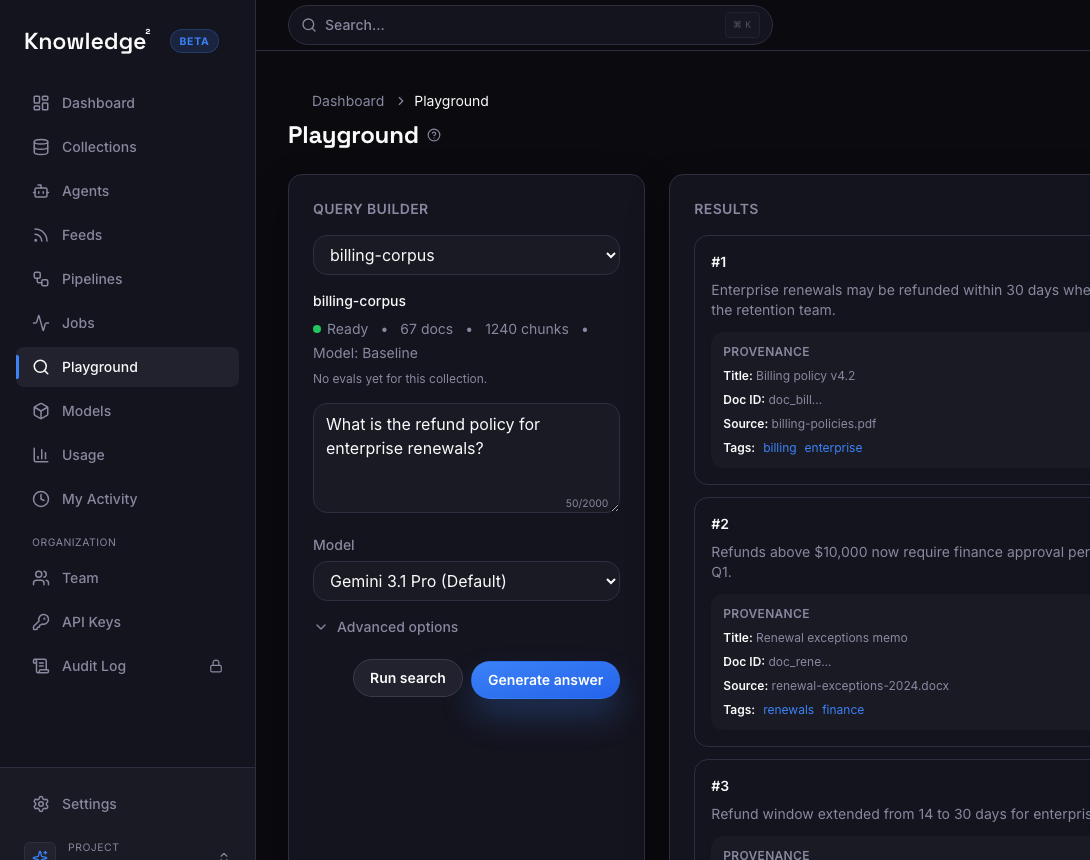
Knowledge² Python SDK

  • Official client on PyPI and GitHub
  • One client spanning ingest, search, tuning, deployment, and operations
  • A straightforward starting point for programmatic evaluation
Product screenshot
02

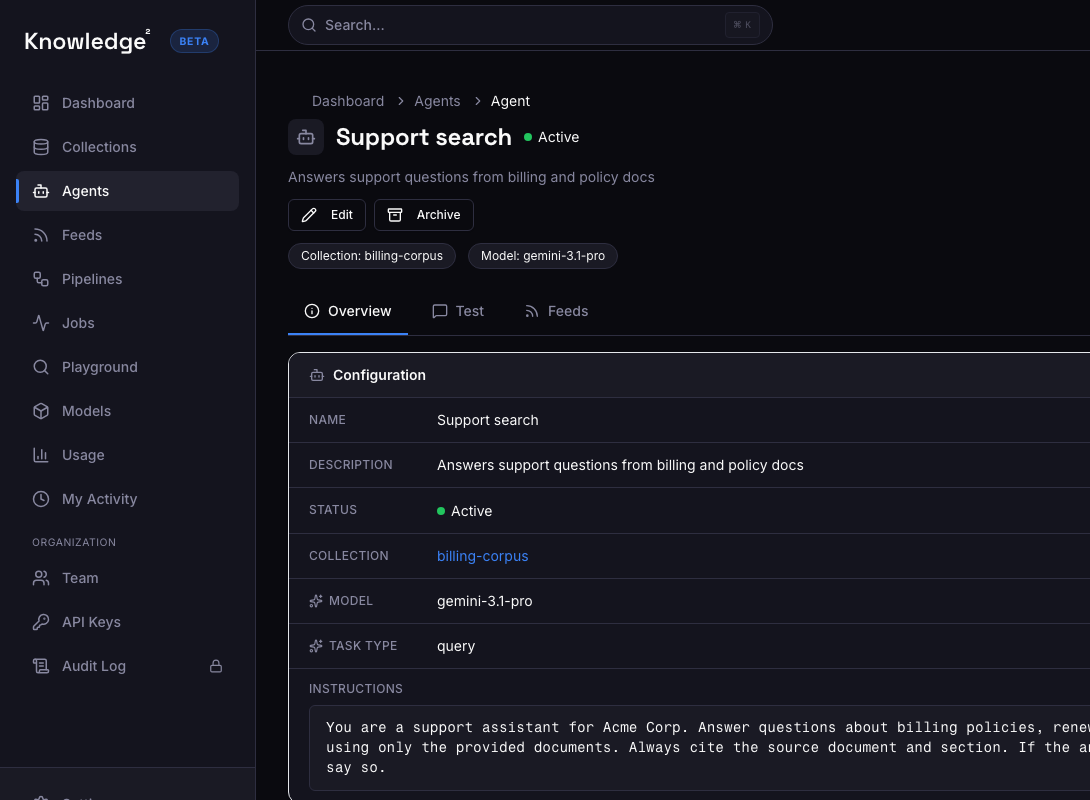
Knowledge² TypeScript SDK

  • Official Node and TypeScript client on GitHub and npm
  • Covers the core retrieval workflow plus agents, feeds, pipelines, and A2A
  • A clean fit for Next.js backends, worker services, and Node tooling
Product screenshot
03

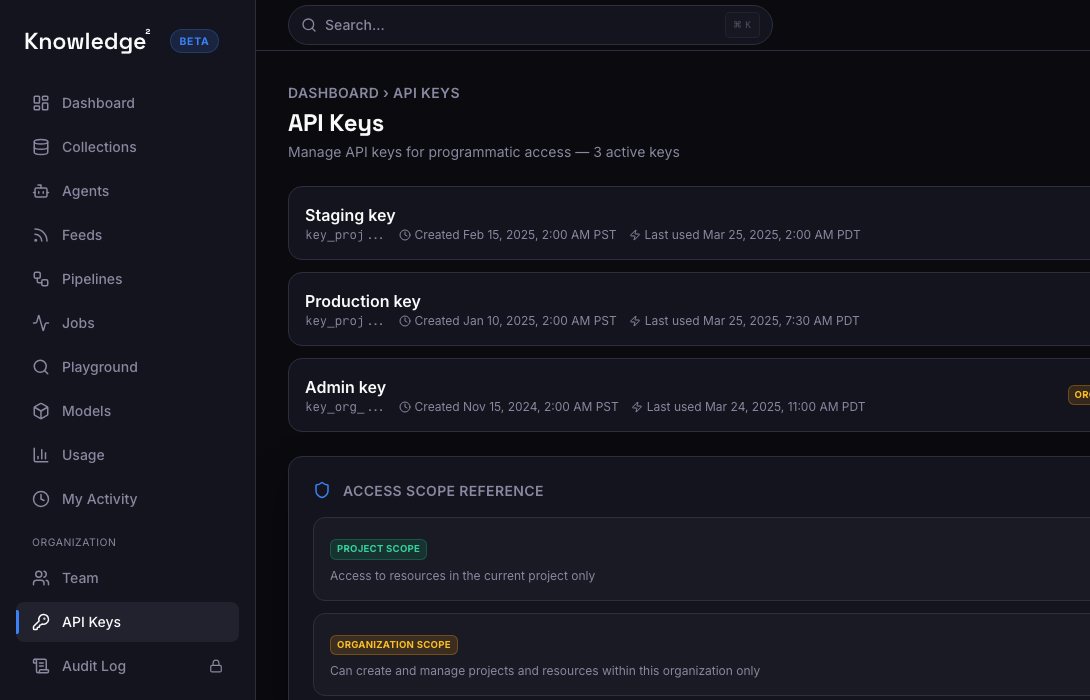
Knowledge² docs

  • Public getting-started guide and API reference
  • Framework integration documentation for LangChain and LlamaIndex
  • The clearest view of the hosted developer surface before implementation
Product screenshot
04

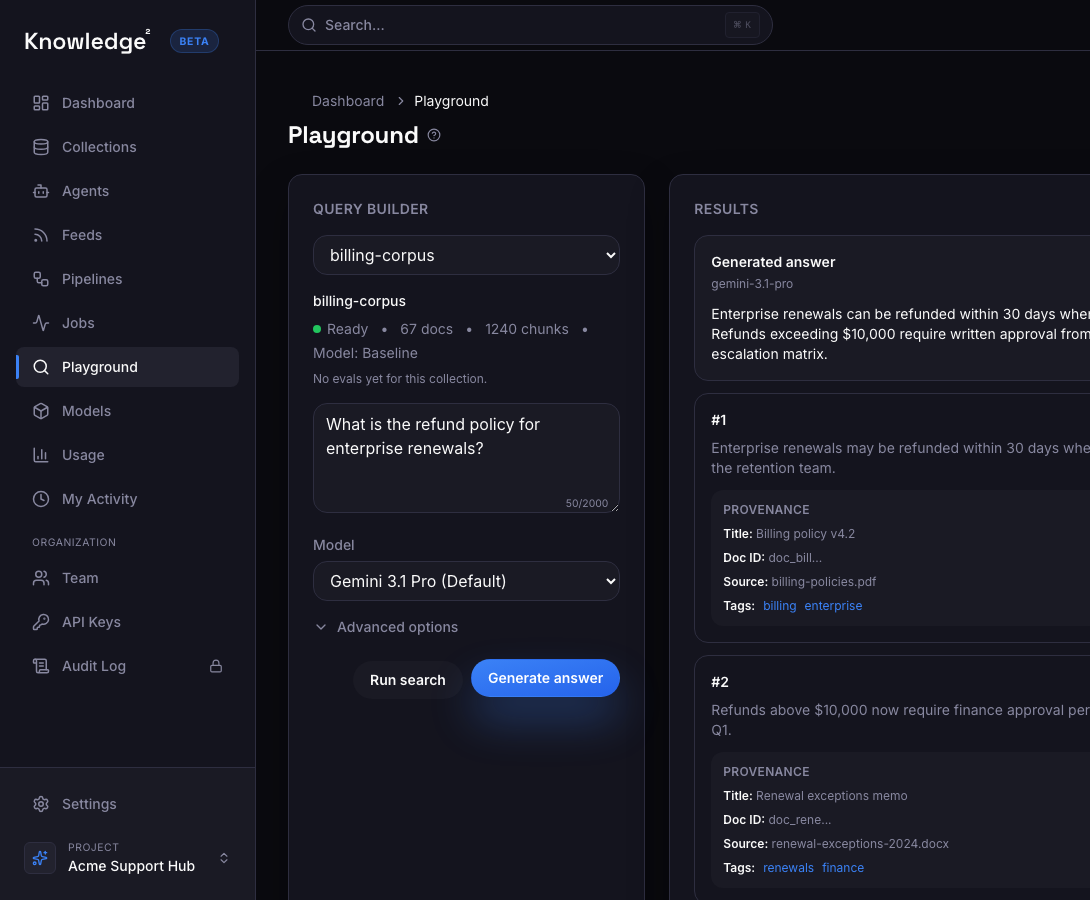
Knowledge² examples

  • Runnable SDK lifecycle examples
  • Released LangChain and LlamaIndex examples for common adoption patterns
  • A practical way to test implementation fit with less guesswork
Product screenshot
05

Production-friendly integration behavior

  • Automatic retries and rate-limit handling
  • Pagination and predictable error handling for long-lived integrations
  • Auth patterns that support both hosted and self-managed deployments
Product screenshot

What this looks like in a product

A team reaches a working pilot without reverse-engineering the platform

The public SDK, docs, and examples should be enough to get a real evaluation moving without a long setup cycle.

  • Technical teams can test implementation fit from public repos instead of sales-only material.
  • The first working search flow should fit in a small script.
  • Teams can layer K² into LangChain or LlamaIndex when that is the right fit.

Example quickstart outcome

A product engineer gets the first answer working in one pass

The goal is a usable baseline, not a month of setup.

Question

How do I rotate an API key?

Returned result

API keys can be rotated from Settings > Security. Existing keys remain valid until revoked, which lets you stage the rollover safely.

  • Project created: Support Search
  • Corpus created: Product Docs
  • First search result returned

Implemented with the Knowledge² TypeScript SDK

Keep the implementation surface small

TypeScript SDK example

TypeScript
import { Knowledge2 } from "@knowledge2/sdk";const client = new Knowledge2({ apiKey: process.env.K2_API_KEY! });const project = await client.projects.create("Support Search");const corpus = await client.corpora.create(project!.id, "Product Docs");await client.documents.upload(corpus!.id, { rawText: "API keys can be rotated from Settings > Security...", metadata: { source: "security-docs" },});const results = await client.search.query(corpus!.id, { query: "How do I rotate an API key?", topK: 5,});

Illustrative quickstart response

JSON
{ "project_id": "proj_support_search", "corpus_id": "corp_product_docs", "results": [ { "score": 0.97, "text": "API keys can be rotated from Settings > Security..." } ]}
  • Cited evidence on every answer
  • Tenant-scoped access controls
  • Audit logging
  • VPC / on-prem deployment
  • SOC 2 readiness

With Knowledge², our customers go from scoping to a working proof-of-concept in minutes, not weeks. Their technical and business teams move in lockstep instead of stalling on infrastructure. The ability to deploy within regions that have strict data residency requirements removes the last blocker to adoption.

Bruno Machado, CEOElevata